Lifting Banking Limits in Korea: How to Remove the ₩300,000 Daily Cap (2026 Guide)
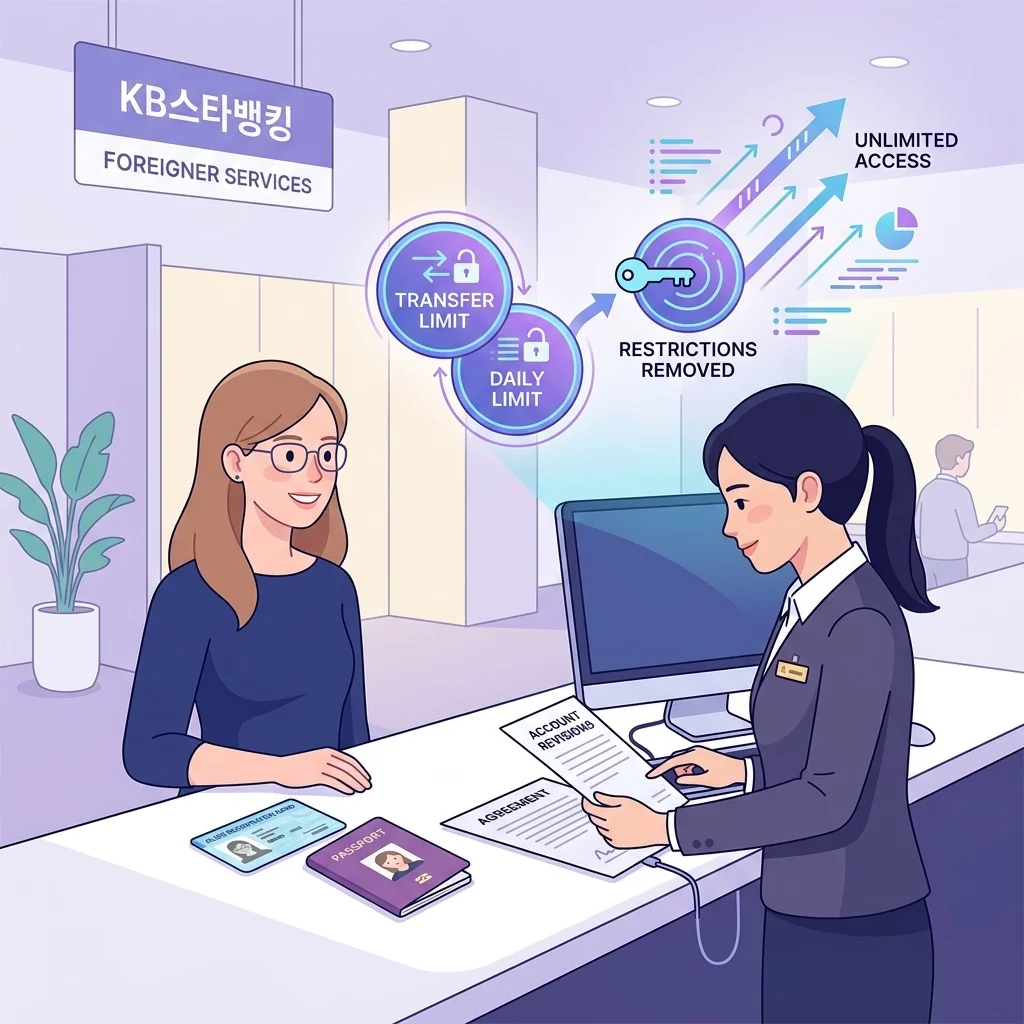
You just arrived in Korea, opened a bank account, and now you can't even pay your rent. Your shiny new debit card works fine at the convenience store, but the moment you try to transfer more than ₩300,000 in a single day, the app throws up a wall. No explanation in English. Just a cold rejection. If you've ever been confused by this, you're not alone — it's the single most common banking complaint among foreigners in Korea.
📌 This article provides general information based on official published data. Always consult a qualified financial advisor before making investment or insurance decisions.
What Is a Financial Limit Account (한도제한계좌)?
A Financial Limit Account caps your daily online transfers to ₩300,000 and ATM withdrawals to ₩1,000,000. Every bank in Korea — KB Kookmin, Shinhan, Hana, Woori, NH Nonghyup, and the internet-only banks — is required by the Financial Supervisory Service (FSS) to apply this restriction to new accounts opened by both Korean citizens and foreign residents (as of April 2026).
The policy exists for a serious reason. Korea has among the highest rates of Boisingpising (보이스피싱 — voice phishing fraud) in the developed world. Criminal networks recruit unwitting newcomers to open "mule accounts" for laundering stolen funds. By capping new accounts at ₩300,000, the Financial Supervisory Service (FSS) → makes it nearly impossible for scammers to move large sums through freshly opened accounts.
The catch? Legitimate expats get swept up in the same net. The teller who opens your account won't always tell you this, and the restriction notice is almost never provided in English. You usually discover it when you try to wire your first month's rent to your landlord and the transfer silently fails.
The Exact Limits You're Dealing With
A common mistake is assuming there's just one limit. Your Financial Limit Account actually restricts multiple transaction types simultaneously. Understanding the full picture helps you plan around the restrictions while you prepare the documentation to lift them.
| Transaction Type | Limited Account Cap | After Limit Removed |
|---|---|---|
| Online/App Transfer (per day) | ₩300,000 | Up to ₩50,000,000+ |
| ATM Withdrawal (per day) | ₩1,000,000 | ₩3,000,000+ |
| ATM Transfer | ₩300,000 | Up to ₩30,000,000 |
| Overseas Remittance | Blocked entirely | Up to $100,000/year |
| Online Shopping / Card Payment | No restriction | No restriction |
Notice that card payments at shops and online stores are not affected — you can swipe or tap without any daily cap. The restriction specifically targets bank-to-bank transfers and cash withdrawals. If your immediate need is just paying for groceries or splitting dinner on KakaoPay, you're fine for now. But if you need to pay rent, send money home, or transfer a jeonse deposit, you have to get this limit lifted.
How to Check If Your Account Is Restricted
Open your bank's mobile app and look for "이체한도" (transfer limit) in the settings menu. If your daily online transfer cap shows ₩300,000, your account is classified as a Financial Limit Account. On KB Star Banking, it's under 계좌관리 → 이체한도조회. On Shinhan SOL, navigate to 전체메뉴 → 이체 → 이체한도 변경. On Hana One Q, tap 계좌/카드 → 이체한도관리.
An even simpler test: just try to transfer ₩500,000 to a friend's account. If it bounces with an error message saying 이체한도초과 (transfer limit exceeded), you have your answer. Don't worry — the attempt won't trigger any flags. It simply won't go through.
Step-by-Step: Removing the Limit at a Bank Branch
For the five major traditional banks (KB, Shinhan, Hana, Woori, NH), the standard path requires an in-person visit. The difference between a smooth 20-minute visit and a frustrating two-hour ordeal comes down to bringing the right documents on day one.
Step 1: Gather your documents. The bank needs to verify your identity, your employment status (or other income source), and your residence. Here's the exact checklist by situation:
Step 2: Visit the branch and take a ticket. Tell the greeter or the kiosk that you need Hando-jehan-gyejwa haeje (한도제한계좌 해제). At larger branches, there's sometimes a dedicated window for foreigner services. At smaller branches, just take a general banking ticket.
Step 3: Submit your documents. The teller will scan everything and enter it into their system. They'll verify your ARC number against the immigration database and cross-reference your employment records. This verification step can take 10–30 minutes depending on the branch's processing speed.
Step 4: Set your new transfer limits. This is the part people forget. After the 한도제한 해제 is approved, ask the teller to increase your daily and per-transaction limits in their system right there. Don't leave the counter until you see the new numbers confirmed on screen. You can typically set online transfer limits anywhere from ₩5,000,000 to ₩50,000,000 per day, depending on the bank and your OTP/security setup.
Step 5: Configure your mobile banking. Before you leave the branch, open your app and verify the new limits are reflected. If they aren't, the teller can push the update from their terminal. Also make sure your Gongdong-injeungseo (공동인증서 — Joint Digital Certificate) is configured for the higher transaction tier.
The Toss Bank Shortcut: No Branch Visit Needed
Toss Bank allows foreigners to lift the Financial Limit Account restriction entirely through the app — no branch visit required (as of April 2026).
This is the biggest game-changer for expats who dread the in-person process. Toss Bank is the most foreigner-friendly internet-only bank in Korea. You can open an account with just your ARC and complete the limit upgrade by uploading photos of your employment documents directly in the app.
"Toss Bank serves over 9 million customers as of 2026, with a growing share of foreign resident users who benefit from its mobile-first verification system." — Toss Bank Official →
The process inside the Toss app: tap 전체 → 계좌 → 이체한도 관리 → upload your Certificate of Employment and a recent payslip. Review typically takes 1–3 business days, and you'll get a push notification when it's approved. No commute, no queuing, no language barrier at the counter.
Kakao Bank, on the other hand, remains more restrictive for foreigners. While it has improved, many expats still report difficulty reaching the same service level. If you want the smoothest mobile-first experience, Toss Bank is currently the strongest option.
What If the Bank Rejects Your Request?
It happens. And it's maddening. But it doesn't mean you're stuck. Here are the most common rejection reasons and how to handle each one.
Some banks want to see 3+ months of regular salary deposits before they approve the upgrade. If you just arrived and opened the account last week, the bank may ask you to wait. The fix: have your employer direct-deposit your salary into the account, set up autopay for at least one utility bill, and come back after 3 months of consistent activity.
Rejection Reason 2: "Documents are expired or incomplete." Your Certificate of Employment must be dated within the last 3 months, and every document should be an original — not a photocopy. If your HR department gives you an undated or unsigned letter, the bank will reject it. Ask specifically for the official company stamp (직인) and a recent date.
Rejection Reason 3: "Your visa type doesn't match." If you're on a short-term visa (C-series), some banks flatly refuse to lift the restriction because the FSS categorizes short-term visitors as high-risk. This is where it gets bureaucratic: you may need to upgrade your visa status first, or try a different bank that interprets the guideline more flexibly. In practice, Hana Bank and Shinhan Bank tend to be more accommodating in these edge cases.
Required Documents by Purpose
The exact documents the bank asks for depend on why you need the account — not just who you are. Banks are trained to match your stated Geunyung-georae-mokjeok (금융거래목적 — purpose of financial transactions) to the correct evidence category.
| Purpose | Required Documents |
|---|---|
| Salary Receipt | Certificate of Employment, payslips, employment contract, NHIS qualification certificate |
| Business Operations | Business registration certificate, tax invoices, VAT filing proof, supply contracts |
| Pension Receipt | Pension certificate, NPS beneficiary confirmation letter |
| Rent / Utility Payments | Lease agreement, utility bill receipts, apartment management fee statements |
| Student Tuition | University enrollment certificate, tuition invoice, D-2 visa proof |
A quick scenario: Let's say you're an E-7 visa holder earning ₩3,500,000/month, and you need to transfer ₩10,000,000 for a wolse deposit. You'd bring your Certificate of Employment, your lease contract showing the deposit amount, and your latest 3 payslips. The bank sees your stated income matches the transaction amount, and they approve the limit lift. The numbers: your combined documentation proves roughly ₩10.5M earned over 3 months, more than enough to justify a one-time ₩10M transfer.
OTP, Security Cards, and Digital Certificates: The Authentication Layer
Even after the Financial Limit Account restriction is removed, your maximum daily transfer amount depends on which security method you use. Korea's banking system operates on a tiered authentication model.
With just an SMS verification code, your ceiling might be ₩5,000,000/day. Add a Gongdong-injeungseo (공동인증서 — Joint Digital Certificate), and it jumps to ₩100,000,000. Combine the digital certificate with a physical OTP (One-Time Password) device — the small keychain-sized gadget you can get at any branch for about ₩3,000–5,000 — and you unlock the highest tier, suitable for property transactions and large remittances.
If you're planning to send money overseas, you'll almost certainly need the Joint Digital Certificate. Getting one is free and takes about 15 minutes at the bank. Ask for the "공동인증서 발급" service — the teller will walk you through installing it on your phone. Without it, your overseas remittance options will be severely capped even after the limit is lifted.
Bank-by-Bank Comparison: Foreigner Experience
Not all banks treat foreigners equally. After checking with several branches across Seoul, here's an honest ranking of how the Big 5 + Toss Bank handle limit removal for foreign residents.
| Bank | Foreigner UX | App-Based Removal? | Notes |
|---|---|---|---|
| Toss Bank | ⭐⭐⭐⭐⭐ | Yes | Best for expats. Full English support. Upload docs in-app. |
| Hana Bank | ⭐⭐⭐⭐ | No (branch only) | Foreigner-dedicated windows at major branches. Hana EZ app in English. |
| Shinhan Bank | ⭐⭐⭐⭐ | Partial | Some document uploads via SOL app. Final approval may require branch. |
| KB Kookmin | ⭐⭐⭐ | Partial | Auto-upgrade possible if 3+ months salary history. KB Star app improving. |
| Woori Bank | ⭐⭐⭐ | No | Branch-only. Good for large transactions and Woori WON app in English. |
| NH Nonghyup | ⭐⭐ | No | Stricter documentation. Often requires multiple visits. |
If you're starting from scratch, Toss Bank is the clear winner for convenience. If you already have a salary account at one of the traditional banks, it's usually easier to keep that account and just do the branch visit than to move your entire payroll setup. As of 2026, the most practical option is having two accounts — your salary account at a major bank, plus Toss Bank as your daily-use transfer workhorse.
The 3-Month Auto-Upgrade Trick
Here's something the bank won't proactively tell you. Several major banks — KB Kookmin and Shinhan in particular — have an internal policy where the Financial Limit Account status is automatically reviewed and potentially lifted after 3 months of consistent financial activity. The catch is that the system evaluates you passively. There's no notification telling you "congratulations, your limit has been upgraded."
To maximize your chances of automatic approval, do all of the following from day one:
After 3 months of clean activity, check your transfer limit in the app. If it still shows ₩300,000, call the bank's customer service line (most have English-speaking agents) and ask them to run a manual review. Having consistent salary deposits on record makes a compelling case that your account is legitimate — and the review usually takes just 1–2 business days.
Frequently Asked Questions
Can I lift the limit without proof of employment?
Yes, but you need alternative proof of financial activity. Self-employed foreigners can use their business registration certificate (사업자등록증) and recent tax invoices. Students can provide enrollment certificates and tuition payment receipts. If you receive a pension from abroad, a pension certificate will work. The core principle is proving that money flows into and out of your account for legitimate reasons — employment is just the most common path, not the only one.
Does this limit apply to Kakao Pay and Naver Pay transfers?
These services have their own separate limits, which are typically lower. Kakao Pay and Naver Pay operate as "simple payment" platforms that link to your bank account. Even if your bank limit is lifted, these services cap peer-to-peer transfers at around ₩500,000–₩2,000,000/day depending on your verification level and linked bank. Think of them as an additional layer on top of your bank's own limits.
What happens if my ARC expires while my account is active?
Your account may be automatically restricted again. Korean banks regularly cross-check ARC validity with the immigration database. If your ARC lapses — even temporarily during a visa renewal — the bank's system can re-apply the Financial Limit Account status. Keep your ARC current, and if you're between renewals, bring your visa extension receipt (접수증) to the bank proactively to prevent a freeze.
Is there a way to make a large one-time transfer without lifting the limit?
Yes — visit a teller and request a counter transfer. Even with a limited account, you can execute large transfers at the physical counter by presenting your ID, the purpose of the transfer, and relevant documentation (like a lease contract). The teller processes it as an over-the-counter transaction, bypassing the online limit. This is commonly used for jeonse deposits. Expect the teller to request the same documentation you'd need for a full limit removal.
Bookmark this one — you'll need it. The ₩300,000 cap is one of those invisible walls that catches every newcomer off guard. But it's entirely solvable with the right documents and a single bank visit (or a 5-minute Toss Bank upload). Don't wait until you have an urgent rent payment due. Handle this in your first month, and you'll save yourself a world of stress later.
※ All information is based on 2026 statutory rates and official publications. Individual circumstances may vary. This is not professional financial, medical, or legal advice.
Independent operator of KR INSIDER · in Korea since 2018 · naturalized citizen (2022). Personally navigated ARC, visa renewals, Jeonse contracts, tax filings, and NHIS/NPS enrollment. This page was researched from official sources and verified against 2026 statutory rates. Rules change frequently — always confirm with the relevant office before deciding.