International School Costs in Korea 2026: Full Breakdown by Tier
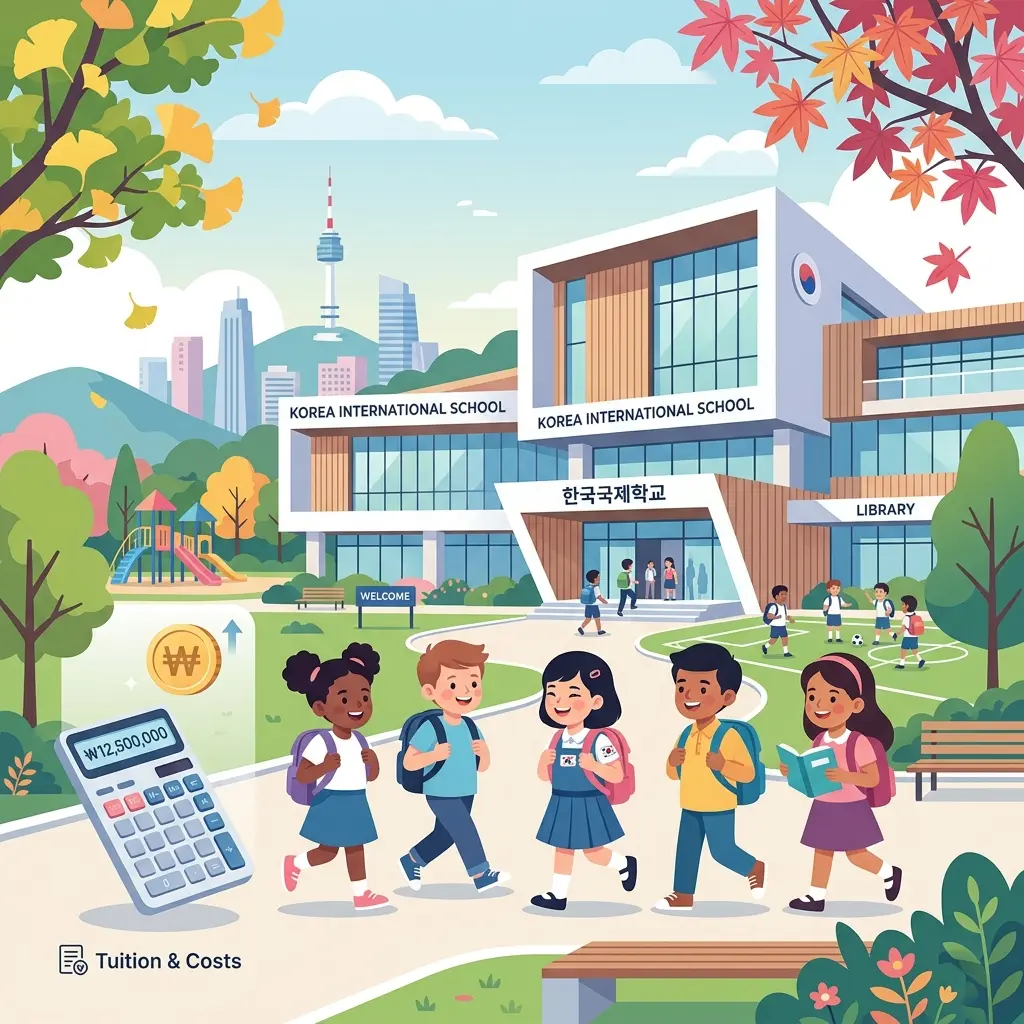
Here is the honest truth about international schools in Korea: what you see on the brochure is rarely what you pay. Every year, expat parents budget strictly for the 'base tuition' only to get completely blindsided by capital levies, transportation fees, and non-refundable deposits during their first semester. The gap between budget and reality is bigger than you'd expect. As of 2026, navigating the Korean international school system requires more than just picking a curriculum; it requires serious financial planning.
📌 This article provides general information based on official published data. Always consult a qualified financial advisor before making educational investment decisions.
What is the True Cost of International Schools in Korea?
The true cost ranges from ₩12 million to over ₩42 million annually in 2026, depending on the tier. Expect to pay an additional 10-30% on top of base tuition for mandatory fees like capital levies, buses, and lunches.
If John, an E-7 visa holder, is considering a premium school for his two children, he isn't just looking at a simple ₩30,000,000 fee. He is looking at a complex matrix of split-currency payments. Most top-tier schools in Seoul—such as Seoul Foreign School (SFS), Korea International School (KIS), or Chadwick International in Songdo—require tuition to be paid partially in USD and partially in KRW.
For example, a typical 6th-grade tuition might be listed as $14,000 USD + ₩18,000,000 KRW. This split protects the school from currency fluctuations, but it transfers that risk directly to you. If the USD to KRW exchange rate spikes, your effective cost in Won increases dramatically. Most families only look at the published base tuition rates. However, the real financial burden lies in the mandatory extras.
To make sense of the market, we must break schools down into three distinct tiers based on their fee structures for the 2026/2027 academic year. Let's break this down without the jargon. The market essentially operates in three brackets.
| School Tier | Estimated Base Tuition (Annual) | Typical Profile |
|---|---|---|
| Budget Tier | ₩8,000,000 – ₩20,000,000 | Smaller, faith-based, US curriculum |
| Mid-Range Tier | ₩20,000,000 – ₩28,000,000 | Established IB/AP schools, broader facilities |
| Premium Tier | ₩28,000,000 – ₩42,000,000+ | Elite legacy schools (e.g., KIS, SFS, Chadwick) |
In the Budget Tier, you will find smaller, often faith-based schools. These institutions might lack Olympic-sized swimming pools or massive performing arts centers, but they offer solid American-style curricula. Here, you might pay entirely in KRW, avoiding the exchange rate headache.
The Mid-Range Tier includes highly respected schools that may be slightly further from central Seoul, or have a slightly higher ratio of local students. They offer excellent IB (International Baccalaureate) programs and strong college counseling.
The Premium Tier represents the elite legacy schools. These campuses rival small universities in their facilities. They boast extensive extracurricular pipelines into Ivy League and top-tier global universities. If you are enrolling multiple children here, you must calculate the exact Silsabi (실사비 - the actual out-of-pocket expenses beyond tuition). This means meticulously converting both USD and KRW components, as most premium schools charge a split fee.
The "Hidden" First-Year Costs: Capital Levies and Deposits
First-year students face an additional ₩3M to ₩12M in one-time fees, primarily driven by the capital levy, registration fees, and non-refundable application charges.
Let's break down the exact procedural pipeline of paying for your first year. When you first apply, you will encounter the Iphakgeum (입학금 - the initial admission or enrollment fee). This is usually a non-refundable administrative charge just to have your child's application reviewed. It ranges from ₩300,000 to ₩500,000. If you apply to three schools to ensure placement, you are already down ₩1.5 million before anyone is even accepted.
Once accepted, what catches parents off guard is the capital levy or building fund. The bureaucratic intent here is simple: international schools operate as non-profit entities in Korea and receive zero government subsidies for facility expansion. To build new science labs or maintain turf fields, they rely entirely on parent contributions.
Some schools require a one-time, refundable 'Deposit' (often around ₩25,000,000 to ₩30,000,000) that sits in the school's accounts for the duration of your child's enrollment. You get it back when they leave, without interest. If you don't have ₩30 million liquid cash sitting around, schools offer an alternative: a non-refundable annual capital fee, usually around ₩4,000,000 per year. Over a 10-year education, you end up paying ₩40 million that you never get back. This is a crucial decision point.
Beyond the initial shock of the capital levy, you need to budget for the day-to-day operations. Transportation in Seoul is extensive, but school bus fees are notoriously high. Because these schools are located in exclusive enclaves like Hannam-dong, Seongbuk-dong, or out in Pangyo, public transit isn't always viable. Expect to pay between ₩2,500,000 and ₩3,500,000 annually per child just for the bus. Add another ₩1,000,000 to ₩1,500,000 for mandatory cafeteria lunches, and you've already added nearly ₩5M to your base cost before buying a single uniform.
"Official tuition policies for designated foreign schools dictate that additional fees such as transportation, meals, and extracurricular activities must be itemized separately from standard curriculum tuition." — Ministry of Education (MOE) Policy Brief, January 2026.
How to Structure Corporate Education Packages in 2026
To avoid massive out-of-pocket expenses, negotiate your corporate education allowance based on "Total Actual Cost" including capital levies, EAL fees, and tax gross-ups, rather than just base tuition.
If you are relocating to Korea on an expat package, negotiating your education allowance is the single most important financial conversation you will have with HR. Many executives negotiate a blanket "$30,000 per child" allowance, assuming it will cover everything. It won't. You must negotiate based on 'Total Actual Cost'.
When drafting your employment contract, ensure that the language explicitly covers the following items: Registration and Application Fees, the Capital Levy (specify whether the company will float the ₩30M refundable deposit, or pay the ₩4M annual non-refundable fee), and EAL (English as an Additional Language) Fees. If your child is not a native English speaker, almost all premium schools will mandate EAL classes for the first two years. This is not optional, and it costs an additional ₩3,000,000 to ₩5,000,000 annually.
Furthermore, you must ensure the allowance is grossed up for taxes. Korea's comprehensive income tax brackets can reach up to 49.5% for high earners. If your company pays ₩40,000,000 in school fees on your behalf, the National Tax Service (NTS) → views that as ₩40,000,000 of extra income. Without a gross-up provision, your May tax return will result in a devastating bill.
Who is Eligible? The 3-Year Rule vs. Jeju Exception
To enroll in a standard foreign school, the student must hold a foreign passport or have lived overseas for at least 3 years (1,095 days). Jeju Global Education City schools are exempt from this rule.
Korea strictly regulates who can attend a Woegugin Hakgyo (외국인학교 - designated foreign school). The government's intent is to prevent the domestic educational system from draining talent and capital into international schools. The rules are absolute. If your child holds a foreign passport, they are generally eligible. However, if your child holds a Korean passport (including dual citizens in some cases), they must have resided abroad for a minimum of 3 years (exactly 1,095 days) to qualify.
This is not a casual "three years" that you can estimate. The Ministry of Education requires exactly 1,095 days of overseas residency. You will need an official Certificate of Entry and Exit from Korean immigration to prove this. Immigration math is unforgiving.
The major exception to this rule is the Jeju Global Education City. Schools located there, such as North London Collegiate School (NLCS), Branksome Hall Asia, St. Johnsbury Academy, and Korea International School (KIS) Jeju, do not require Korean nationals to have lived abroad. This makes them highly competitive. While the tuition is similar to Seoul, you must factor in boarding fees if you are not relocating your entire family to Jeju. Boarding can add an additional ₩15,000,000 to ₩20,000,000 annually.
You can verify current exemptions and regulations directly on the Ministry of Education Website →.
Frequently Asked Questions (FAQ)
Do international schools in Korea offer scholarships?
Yes, but they are extremely limited. Most scholarships are strictly needs-based financial aid rather than merit-based. You must submit detailed tax returns and bank statements to apply, and they usually cover 10-30% of tuition.
It's important to note that premium tier schools rarely advertise full rides. Financial aid is typically reserved for families facing sudden hardship or those who enhance the diversity of the student body. Do not rely on scholarships as a primary funding strategy.
What is the difference between an International School and a Foreign School?
By Korean law, a "Foreign School" restricts Korean citizen enrollment to 30% of the student body and requires the 3-year overseas residency. "International Schools" in Free Economic Zones have looser domestic enrollment limits.
In everyday conversation, expats use the terms interchangeably, but the legal distinction dictates admissions eligibility. Always confirm the school's legal status before applying if your child holds dual citizenship or a Korean passport.
Are corporate tuition packages taxed as income in Korea?
Yes, corporate education allowances are generally considered taxable fringe benefits in Korea. The tuition paid by your employer will be added to your gross income, potentially pushing you into a higher tax bracket.
If you are negotiating an expat package, ask your HR department if the education allowance is "grossed up." A gross-up means the company pays the additional tax burden caused by the tuition benefit. Without it, a ₩40,000,000 tuition package could result in a massive surprise tax bill in May.
※ All information is based on 2026 statutory rates and official publications. Individual circumstances may vary. This is not professional financial, medical, or legal advice.
Independent operator of KR INSIDER · in Korea since 2018 · naturalized citizen (2022). Personally navigated ARC, visa renewals, Jeonse contracts, tax filings, and NHIS/NPS enrollment. This page was researched from official sources and verified against 2026 statutory rates. Rules change frequently — always confirm with the relevant office before deciding.