Korea Double Taxation Agreements Explained: How to Avoid Paying Tax Twice (2026 DTA Guide)
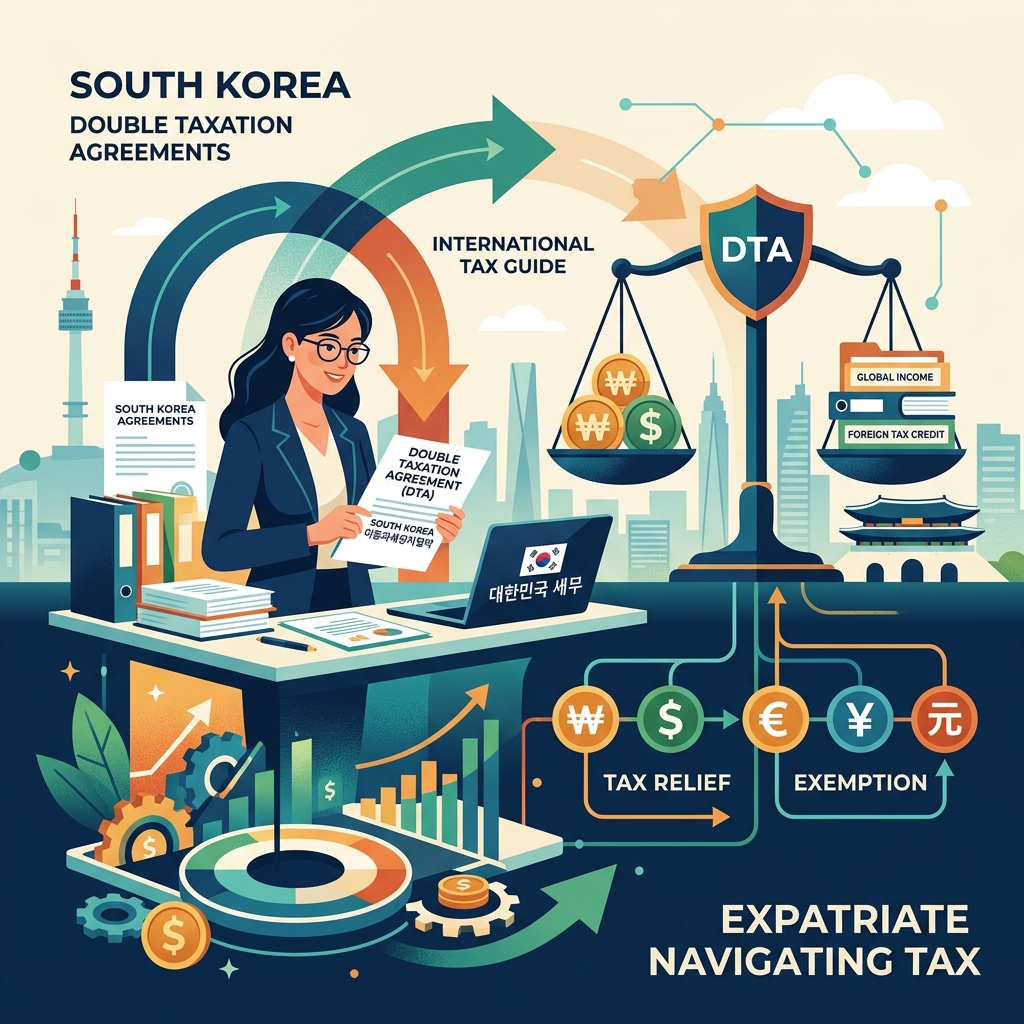
Here is the honest truth about international taxation in South Korea: moving your money across borders without an active strategy is the fastest way to shrink your net worth. As we move through 2026, the National Tax Service (NTS) has implemented highly aggressive tracking for offshore assets, and their definition of who owes what has expanded significantly. The difference between properly filing for treaty relief and accidentally dual-paying both the IRS and the NTS is very real.
📌 This article provides general information based on official published data. Always consult a qualified financial advisor before making investment or insurance decisions.
What is a Double Taxation Agreement (DTA)?
A Double Taxation Agreement (DTA) is a bilateral treaty that prevents identical income from being fully taxed by two separate countries. It offers relief through lower withholding rates on passive income, or by granting foreign tax credits in your country of residence.
The core philosophy of a DTA is simple: you should pay tax to the country where the money was earned (the source country), and the country where you currently live (your resident country) should respect that initial payment. Without this bilateral tax shield, an expat earning offshore dividends in the UK while living in Seoul could legally owe up to 45% to HMRC and an additional 49.5% to the NTS on the exact same dollar.
According to the National Tax Service →, these treaties dictate the maximum "withholding tax" rate that a foreign country is permitted to levy on a Korean resident's income. For example, while standard tax on royalties might be 20%, a specific DTA might cap it at 10%. The difference stays in your pocket.
The 2026 Residency Trap: Who Pays Global Tax?
Before you calculate how a DTA helps you, you must determine if you actually have full Napseuiui mu (납세의무 - Tax liability) to the Korean government. The bureaucratic intent here is to prevent wealthy individuals from using Korea as a tax haven while operating digital businesses overseas.
Historically, Korea looked at a single 183-day block within one calendar year. As of early 2026, the rules are stricter. You are classified as a Geoju-ja (거주자 - Tax resident) if you establish a Korean domicile OR if you maintain a physical presence for a cumulative 183 days spread across two consecutive tax years.
| Expat Tax Status (2026 Rules) | Taxable Scope |
|---|---|
| Non-Resident (Under 183 Days cumulative) | Only income generated inside South Korea. |
| Short-Term Resident (Less than 5 years) | Domestic income + Offshore income ONLY IF remitted to Korea. |
| Full Tax Resident (Over 5 aggregate years) | Worldwide income, regardless of where it is kept. |
This is where most expats trigger audits. If you have crossed that magical 5-year threshold (calculated as an aggregate of the last 10 years), you are completely exposed to the global taxation net. It does not matter if your offshore LLC's profits simply rolled over into an American Vanguard index fund and never touched a Korean bank. You must declare it on your May Comprehensive Income Tax return.
How Do You Claim the Foreign Tax Credit?
If you fall into the category of a Full Tax Resident who is being taxed on global income, the DTA is your lifeline. To avoid dual taxation, South Korean law provides the Foreign Tax Credit (FTC) mechanism.
"Where a resident has paid or is bound to pay foreign income taxes on foreign-sourced income... the foreign income tax amount shall be deducted from the calculated tax amount of the comprehensive income." — Article 57, Income Tax Act of Korea (2026).
Let's map out the scenario math. Imagine you are a US citizen residing in Seoul. You sold a property in California and generated a massive capital gain. The IRS taxes you $20,000. Because you have lived in Korea for 7 years, the NTS also assesses your global income and determines your Korean tax liability on that same property sale is $25,000.
Instead of paying $45,000 total, you file the FTC paperwork containing your IRS payment receipt. South Korea acknowledges the DTA, credits you the $20,000 you paid to America, and you mathematically only owe the NTS the remaining $5,000. You do not pay twice, you simply pay the higher of the two rates.
Be aware of a crucial edge case: the credit limit. The NTS will never grant you a foreign tax credit larger than what your Korean tax would have been on that specific income. If the foreign tax was phenomenally high, the excess credit can generally be carried forward for up to 10 years to offset future offshore gains.
The Procedural Pipeline: Submitting the DTA Forms
Treaty benefits do not trigger automatically by magic just because a treaty exists on paper. Every year, expats lose thousands of dollars to high withholding rates because they assume their employer or brokerage knows their residency status. The burden of proof is entirely on your shoulders.
If you fail to submit the forms in time, the foreign entity will withhold taxes at the maximum statutory rate (often up to 30%). While some countries allow retroactive DTA refunds if you file a petition within 3 years, the bureaucratic friction is immense. Proactive filing is the only logical choice.
Frequently Asked Questions
Does Korea tax foreign rental income?
Yes, if you are a resident over the 5-year mark. Your net foreign rental income is aggregated into your Comprehensive Income Tax return. If you have lived in Korea for less than 5 years, it is only taxable if the rental proceeds are wired into a Korean bank.
How does the 19% Flat Tax interact with foreign income?
The flat tax only applies to domestic employment income. Foreign executives who elect the 19% flat rate for their Korean salary must still file separately for any offshore investment or business income, which is taxed at standard progressive brackets.
Do I need to report my overseas bank accounts?
Yes, if the aggregate balance exceeds 500 million KRW. At any single point during the calendar year, if your combined global accounts cross this threshold, you must file an Overseas Financial Account Report by June 30th. Failure to do so incurs crippling fines up to 20% of the unreported amount.
As 2026 unfolds, navigating the crosslines of DTAs is no longer optional for the global professional. Do not leave your wealth exposed to dual jurisdictions simply because the forms looked intimidating. Consult a bi-lingual CPA early in the year, organize your dividend schedules, and utilize every treaty protection the law affords you.
※ All information is based on 2026 statutory rates and official publications. Individual circumstances may vary. This is not professional financial, medical, or legal advice.
Independent operator of KR INSIDER · in Korea since 2018 · naturalized citizen (2022). Personally navigated ARC, visa renewals, Jeonse contracts, tax filings, and NHIS/NPS enrollment. This page was researched from official sources and verified against 2026 statutory rates. Rules change frequently — always confirm with the relevant office before deciding.